
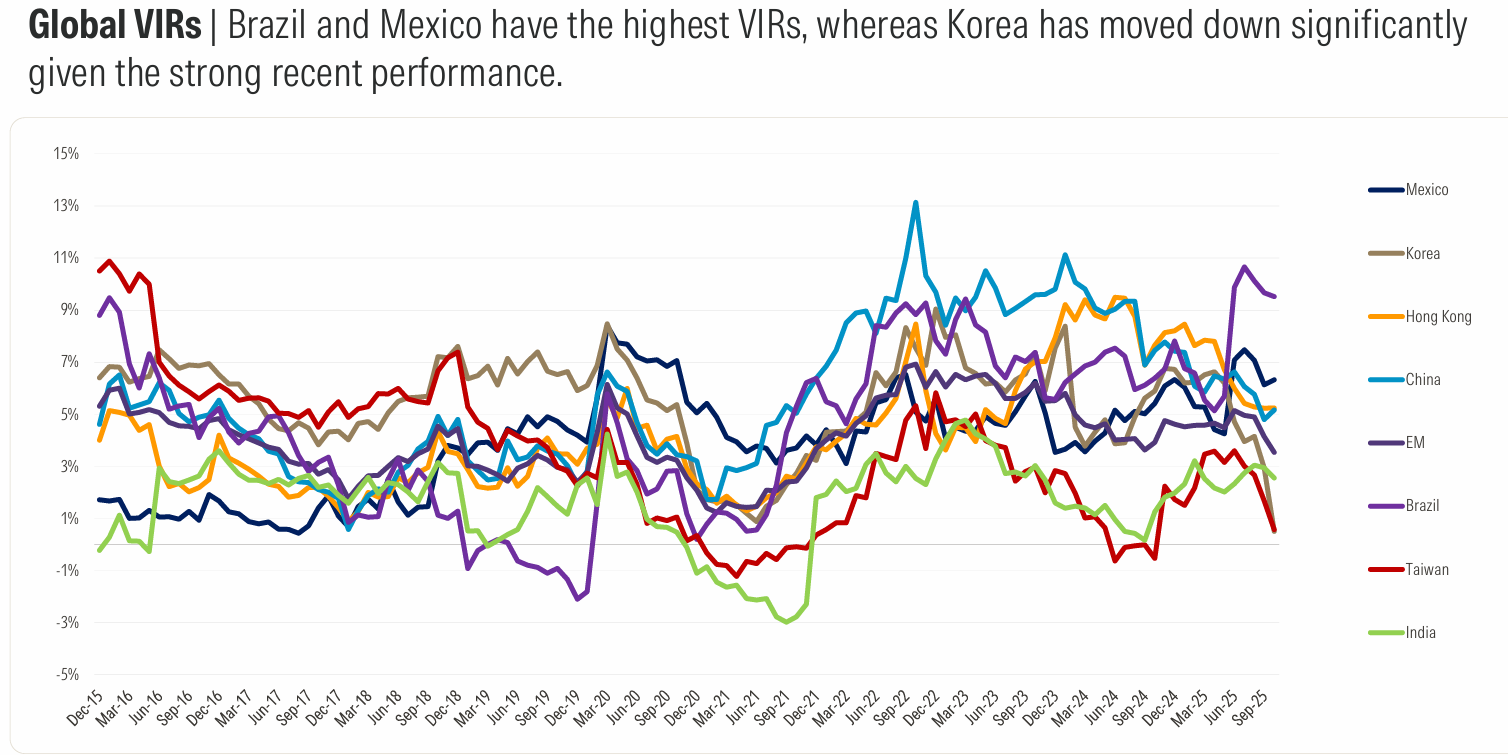
The chart above shows Morningstar’s Valuation Implied Return (VIR) for various country indices in the Emerging Market index since the start of 2016. Brazil is currently offering a VIR of 10%, reflecting high real rates, earnings resilience and attractive pricing relative to the value on offer, on a risk-adjusted basis. Latin America ranks as the most attractive region in USD terms. Currencies have adjusted. Monetary policy has been orthodox and commodity exposure remain supportive in these countries. Compared to the rest of the world, LatAm looks comparatively disciplined, specifically Mexico and Brazil.
More broadly, Emerging Markets still offer compelling value but this is not a “buy the index” moment. The dispersion inside EM is wide and allows Morningstar to be more granular: overweight the countries that are genuinely cheap (Brazil, Mexico) and structurally improving, and avoid those where risk isn’t being compensated (India, Taiwan).
At the same time, valuation opportunities aren’t confined to EM. Morningstar continue to see attractive pricing in developed markets like the UK, and to some extent Japan, where sentiment remains cautious but fundamentals are better than headlines imply.

Despite significant uncertainty as shown by rising market volatility, one of the more interesting features of today’s market is that defensive sectors are not expensive. Both Healthcare and Consumer Staples provide what investors require in such a volatile macro regime namely; earnings durability, strong balance sheets and predictable cash flows. Yet these sectors are trading at sizeable discounts to Morningstar’s fair value estimates. That’s unusual. Given yields on offer, investors are being paid to own resilience.
Communication Services, on the other hand, screens less attractive at the aggregate level. But within the sector, companies like Meta Platforms (Facebook) and Alphabet (Google) are trading at much more reasonable price-to-fair-value levels than they have in recent cycles. Active allocation to attractive opportunities within less attractive sectors, therefore, offers the prospect of adding outperformance to the portfolios.
For the first time in years, fixed income feels structurally useful; not just as ballast, but as a source of real return. The most compelling areas in Morningstar’s framework are US Mortgage-Backed Securities (MBS), US treasuries, UK gilts and Emerging market local currency debt.
When volatility rises, correlations tend to break down and dispersion widens. While these scenarios are uncomfortable for passive exposure; they offer constructive opportunities for Morningstar’s active capital allocation within regions, sectors and asset classes.