A single week in early June 2026 crystallised the defining tension of this investment cycle: the world’s most prominent Artificial Intelligence (AI) safety company (Anthropic) calling for a global pause on frontier AI development; a sovereign nation positioning itself as a launchpad for unregulated Artificial General Intelligence (AGI); and the U.S. government restricting Anthropic’s most capable AI model from release outside its borders. These are early signals of a world reorganising around artificial intelligence.
Market commentators frame the AI race as a chip race, but the companies actually building frontier AI have reached a different conclusion: the binding constraint is electricity. As Nvidia’s Jensen Huang put it: “At the lowest level; i.e. energy, China has twice the amount we have as a nation.” China has responded by wiring solar directly to its AI infrastructure, adding the equivalent of 40% of total US electrical capacity in a single year. The United States, by contrast, is doubling down on fossil fuels, tightening its control over global oil supply.
The U.S. also has a more unconventional response to any energy constraint. SpaceX, following its stock exchange listing, has announced plans to deploy a constellation of satellites functioning as a space-based data centre network; harvesting solar energy in orbit, where it is abundant and uninterrupted, and dissipating heat directly into space, eliminating the cooling burden that accounts for a substantial share of terrestrial data centre energy consumption. If it scales, it won’t just be an incremental improvement on the ground-based model; but a different model entirely. Whether it proves commercially viable at the pace AI infrastructure demands remains to be seen, but it signals that the United States is beginning to look beyond the terrestrial energy grid rather than simply trying to control it. Roelof Botha; long-time business partner of Elon Musk and fellow South African, sees the potential, and has joined the SpaceX board.
In early June, Anthropic revealed that its AI model; Claude, now writes 80% of its own production code, with sobering implications for the software engineering profession, and called for an international pause on frontier AI development as the technology approaches recursive self-improvement. This call finds an uneasy parallel in the U.S. government’s decision to restrict Claude’s most capable model from release outside its borders.
While the U.S tightens controls, Argentina has moved in the opposite direction. President Milei has committed to keeping AI unregulated, created a new “non-human corporation” legal category operated entirely by AI agents, and set a low corporate tax rate to attract AI capital. The relocation of Peter Thiel; co-founder of PayPal and Palantir (and who studied in Namibia) to Buenos Aires, with private meetings with Milei and land acquisitions in Uruguay, adds a pointed anecdotal signal. That someone with his political connectivity and technological foresight is reorienting toward South America is worth noting.
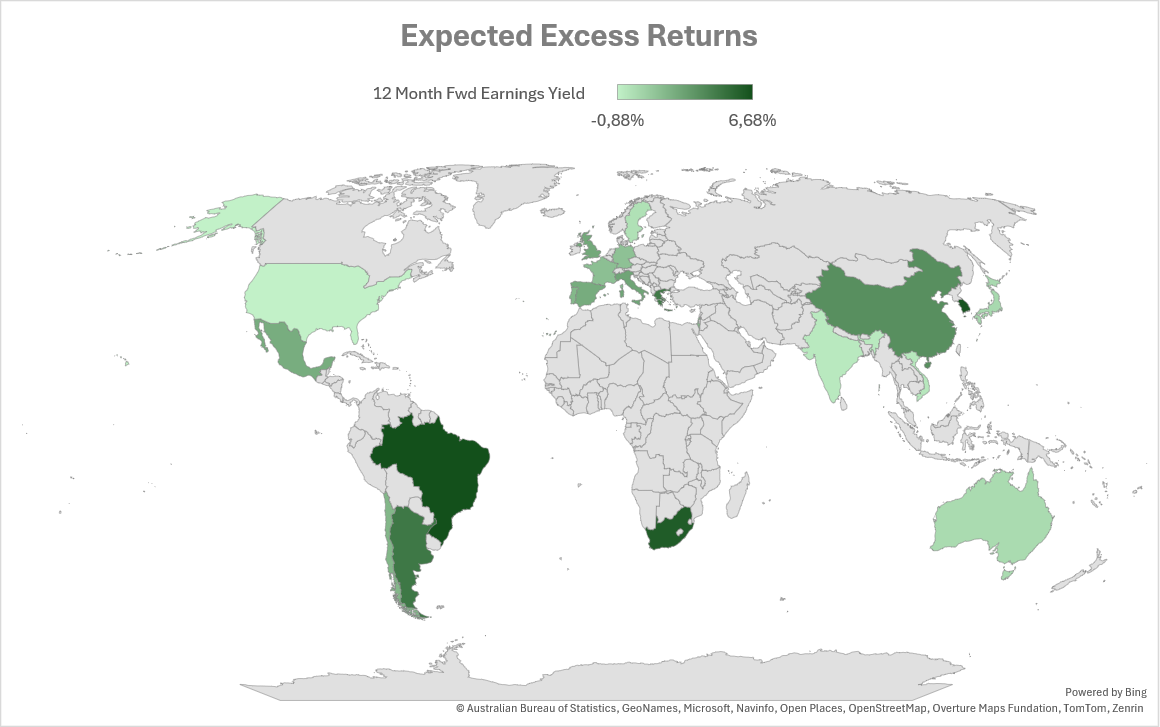
The United States is betting on fossil fuels, chip dominance, tightening AI controls, and; through SpaceX, the possibility of bypassing terrestrial energy constraints altogether. China is betting on solar abundance and grid scale. Argentina is betting that regulatory openness will attract what neither superpower can fully accommodate. Each position will produce winners and losers across energy, semiconductors, and emerging market equities. The Argentine market remains thinly traded with meaningful currency and political risk; Brazil; as Latin America’s most liquid market, and Morningstar’s preferred South American equity market, offers a more considered route to participate in any regional re-rating, should Argentina’s ambitions attract meaningful foreign capital to the continent. Brazil is currently offering the most attractive forward earnings yield of the geographies we monitor.
The below graph denotes the 12-month forward expected excess returns (above the MSCI All Countries World Index). Dark green signals expected outperformance, whereas light green signals expected underperformance. On this basis; Brazil, and South Korea are the most attractively valued relative to the global equity market.