
Geopolitical risk is ultimately a story of geography. A handful of narrow waterways control the flow of the world’s trade, energy, and technology; and whoever controls them holds extraordinary leverage over the global economy.
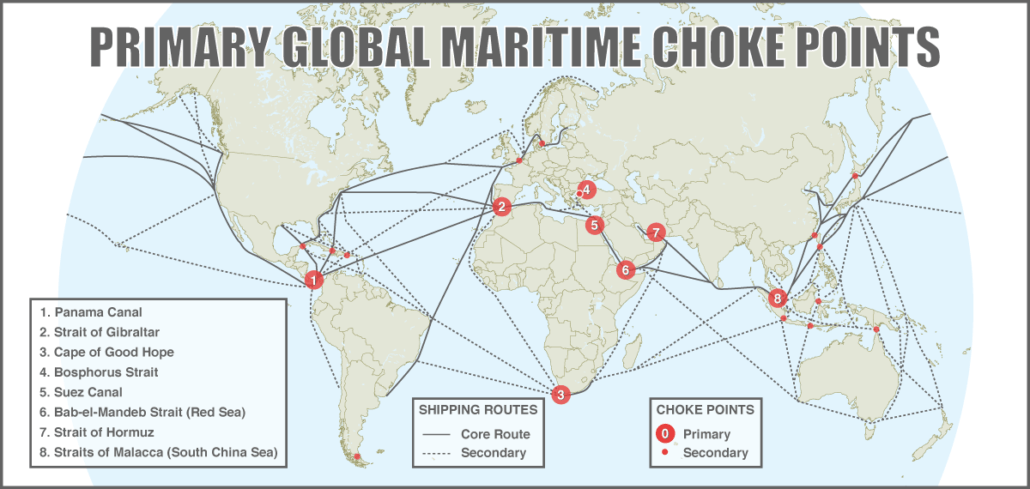
To these traditional primary chokepoints, the 21st century has added a new one: the Strait of Taiwan. If oil defined the last century’s strategic competition, semiconductors are defining this one. While U.S. companies design the world’s most advanced logic chips, Taiwan manufactures them. A closure of the Taiwan Strait would be more economically devastating than any oil embargo in history; no chips means no AI servers, no smartphones, no advanced weapons systems, no modern economy.
To mitigate the risk, the U.S. has responded with a landmark shift in industrial policy. In August 2025, the U.S. government acquired a 9.9% equity stake in Intel for $8.9 billion; moving towards a Chinese model of normalising state capitalism in the semiconductor sector, with a total support package reaching $11.1 billion. The message is unambiguous: semiconductors are the new oil, and market forces alone will not determine who controls this industry.
Much attention has been paid to the Iran war and its effect on the Strait of Hormuz. Less has been paid to its implications for artificial intelligence. AI runs on electricity; vast quantities of it. Roughly half of all data centre power does not go to computation but to cooling: managing the industrial-scale heat generated by GPU chip clusters running at full capacity. A single large AI training run now consumes roughly 50 gigawatt-hours of electricity; enough to power a city the size of Cape Town for several days.
Chip design and manufacturing are critical strategic advantages, but so too is the energy that powers them. The nation that secures the cheapest, most abundant, and most reliable electricity supply will hold a durable structural advantage in AI compute. Energy policy has effectively become AI policy. The Iran war has sharpened this dynamic considerably: energy price spikes hurt across the board, but the United States, as a net energy exporter, carries a meaningful fossil fuel buffer that China does not. In the AI arms race, energy security is a competitive moat.
China is responding aggressively. Beijing is powering its data centres through an accelerated build-out of solar panels and battery storage; an infrastructure programme of extraordinary scale that effectively will allow China to sidestep dependence on volatile fossil fuel markets. It is a long game, but one that China is pursuing with characteristic patience and state-directed capital.
China has not simply accepted the terms of competition set by the United States. On the algorithmic frontier, Chinese researchers have developed models; most visibly DeepSeek, that deliver near-equivalent AI results at a fraction of the training compute required by their U.S. counterparts. This matters enormously: if training efficiency can be dramatically improved, the hardware and energy advantages that the U.S. is building become less decisive.
China also holds a data advantage that is rarely discussed. Its population of 1.4 billion people, operating within a digital ecosystem largely closed to Western competitors, generates vast proprietary datasets unavailable to U.S. AI developers. In machine learning, data volume and quality are as important as raw compute.
Finally, China has pursued a deliberate strategy of releasing its most capable AI models as free, open-source software. U.S. AI companies depend heavily on public equity markets and venture capital to fund their enormous infrastructure build-outs. By releasing capable models for free, China attempts to directly erode the commercial value proposition that U.S. AI companies sell to their investors. It is a form of economic warfare conducted in code.
Strategically, there are four factors that the US and China are vying for leadership of:
- Chip design
- Chip manufacturing and sourcing
- Cheap and abundant energy to power and cool the chips
- Advanced algorithms to control the chips and quality data to train them on
The case for international diversification has rarely been more compelling.
Consider the layers of the value chain. South Korea’s Samsung and SK Hynix are the world’s dominant producers of high-bandwidth memory (HBM) chips; the memory architecture that sits alongside logic chips in AI servers and is indispensable to their performance. Without Korean memory, Nvidia’s most powerful GPUs cannot function.
The Netherlands’ ASML holds a global monopoly on extreme ultraviolet (EUV) lithography machines; the only equipment in the world capable of manufacturing the most advanced chips. Without ASML, neither TSMC nor Samsung can produce next-generation semiconductors.
Japan’s Shin-Etsu Chemical and Sumco are the world’s leading producers of the ultra-pure silicon wafers on which all chips are built.
Germany’s Infineon and Zeiss supply critical power semiconductors and precision optical components respectively.
In the infrastructure layer, Sweden’s Ericsson and Finland’s Nokia are essential to the 5G networks that connect AI systems at scale.
Meanwhile, the copper, cobalt, lithium, and rare earth minerals that underpin the entire physical infrastructure of AI; from cables to batteries to chip substrates, are disproportionately concentrated in emerging markets. Investing across the full value chain remains key, diversifying across regions and investing in less visible undervalued sectors that will still benefit from the AI arms race.
Morningstar continues to find opportunities in these often overlooked regions and sectors across the AI value chain.