
Something interesting is happening that bears a similarity to the telecommunications build-out (typically termed the ‘TMT boom’) of the late 90s.
Back then, the companies laying fibre-optic cable were financed substantially by their own equipment suppliers; in essence a closed loop of owning and owing. Most of these companies did not survive the eventual reset. The lasting beneficiaries emerged later, from a different part of the value chain: Google and, subsequently, Netflix and YouTube, none of which built infrastructure, but which made productive use of the resulting abundance of cheap bandwidth once it existed. The parallel worth drawing for the current AI-boom is that the more durable opportunity may not sit with the companies at the centre of the ownership-and-obligation web, but with the broader set of established businesses; across healthcare, financial services, and other sectors, positioned to benefit from increasingly capable and inexpensive AI tools without carrying the financing risk of having built the underlying infrastructure themselves.
Unpacking this is worth doing because it helps us to understand whether we’re in an AI bubble or not.
A handful of companies feature prominently as part of the discussion; Nvidia, Microsoft, Amazon, Google, and the frontier AI labs OpenAI and Anthropic. Who actually owns a piece of these companies, and who has committed to pay whom for what. The answers turn out to be closely related. Below are the ownership structures of OpenAI and Anthropic, many of the shareholders are also the primary suppliers of the AI companies:
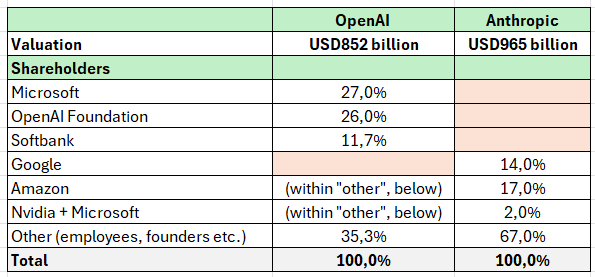
Source: Fintax Research.
Ownership is only half the picture. Alongside these equity stakes sit enormous, multi-year purchase commitments running in the opposite direction: OpenAI alone has committed to roughly $1.15 trillion in infrastructure spending through 2035 across Oracle, Microsoft, Nvidia, AMD, Amazon, Broadcom, and CoreWeave. In several cases, the investor and the recipient of these commitments are the same company; Nvidia both invests in OpenAI and is contractually owed tens of billions of dollars by it for chips; Microsoft holds equity in OpenAI while also being owed billions in cloud-computing spend. Each investor, in other words, is often also a major creditor of the same company, and each transaction supports the appearance of demand for the other.
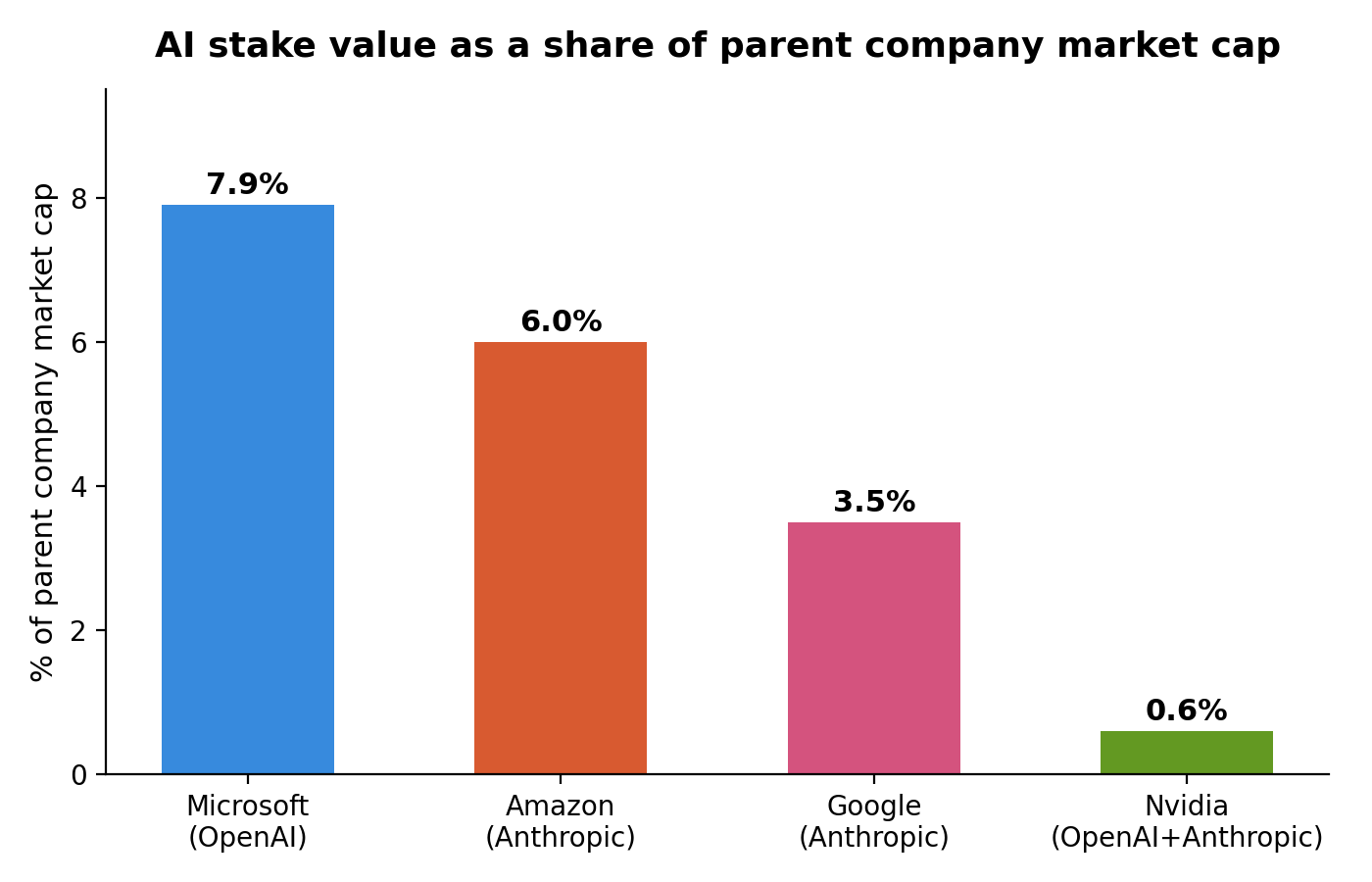
Source: Fintax Research.
Microsoft’s OpenAI stake is worth roughly 8% of Microsoft’s own market capitalisation; Amazon’s Anthropic stake represents a broadly comparable share of Amazon’s value. Neither is large enough to threaten either company outright, but both are large enough that sentiment toward this financing structure can move share prices clients already hold, independent of any direct exposure to “AI stocks” as such.
The associated infrastructure build-out is making many of these companies; Microsoft, Amazon, Google, Nvidia, increasingly capital-intensive, which could weigh on their future margins. Many are funding this build-out not only with cash, but increasingly with debt. Below, we show the capex growth of these companies relative to bond yields. Higher capex growth requires more funding, which raises demand for capital; and the price of that capital is the interest rate. As demand for funding rises, so do rates.
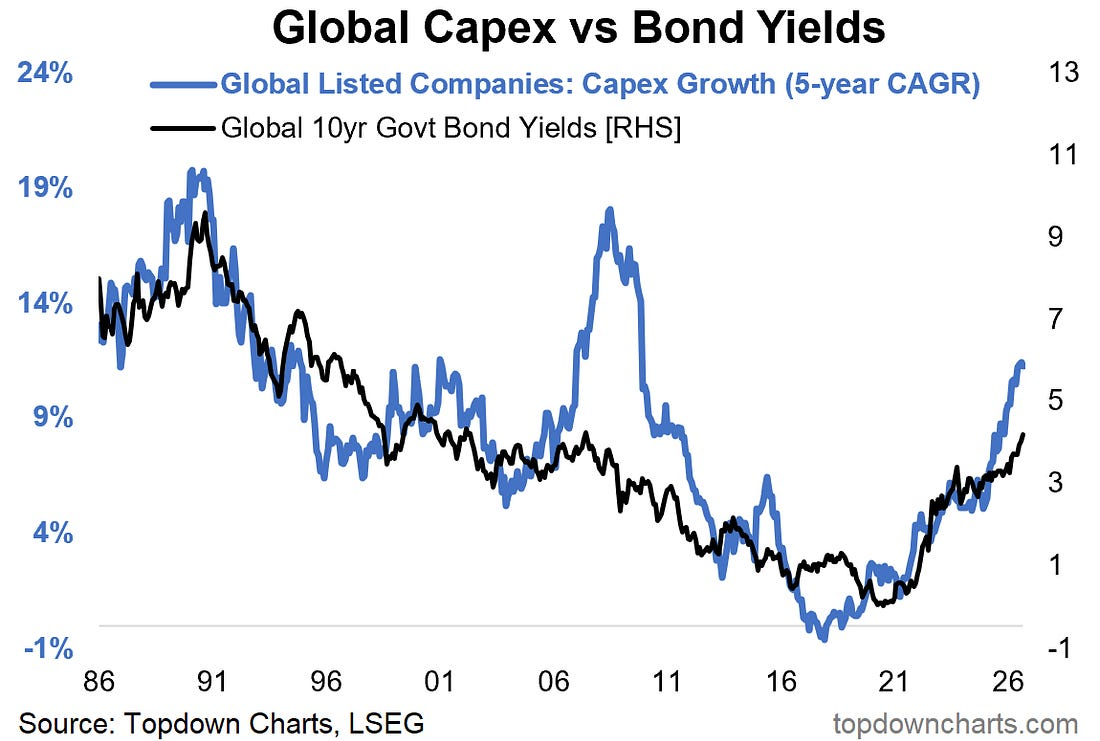
To avoid the risk of investing in companies that are both the suppliers, financiers, and owners of the same companies, in a rising interest rate cycle, it may be worthwhile looking beyond the AI hyperscalers for overlooked opportunities.
Below in green, we show the accelerating earnings growth of companies outside the AI hyperscalers. Notably, earnings growth among index constituents outside the tech and “Magnificent Seven” AI names is beginning to catch up, as these companies start to reap the benefits of the capital-intensive AI infrastructure build-out; primarily by not having to fund the capex themselves.
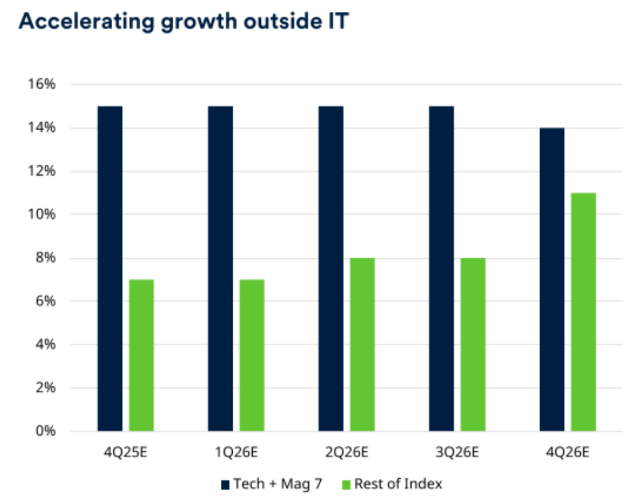
Source: Schroders.
None of this indicates that the AI sector is a bubble waiting to burst; vendor financing has underpinned genuine infrastructure buildouts before. It does, however, mean that a portion of the sector’s reported revenue and valuation gains currently rests on a small, interconnected group of owners and creditors continuing to fund and pay one another, rather than on independently verifiable third-party demand; a distinction worth bearing in mind when assessing AI-related exposure within a diversified portfolio. Just like the TMT boom of the 90s, it may therefore make sense to invest in the companies likely to benefit from the infrastructure build-out, rather than those funding it.